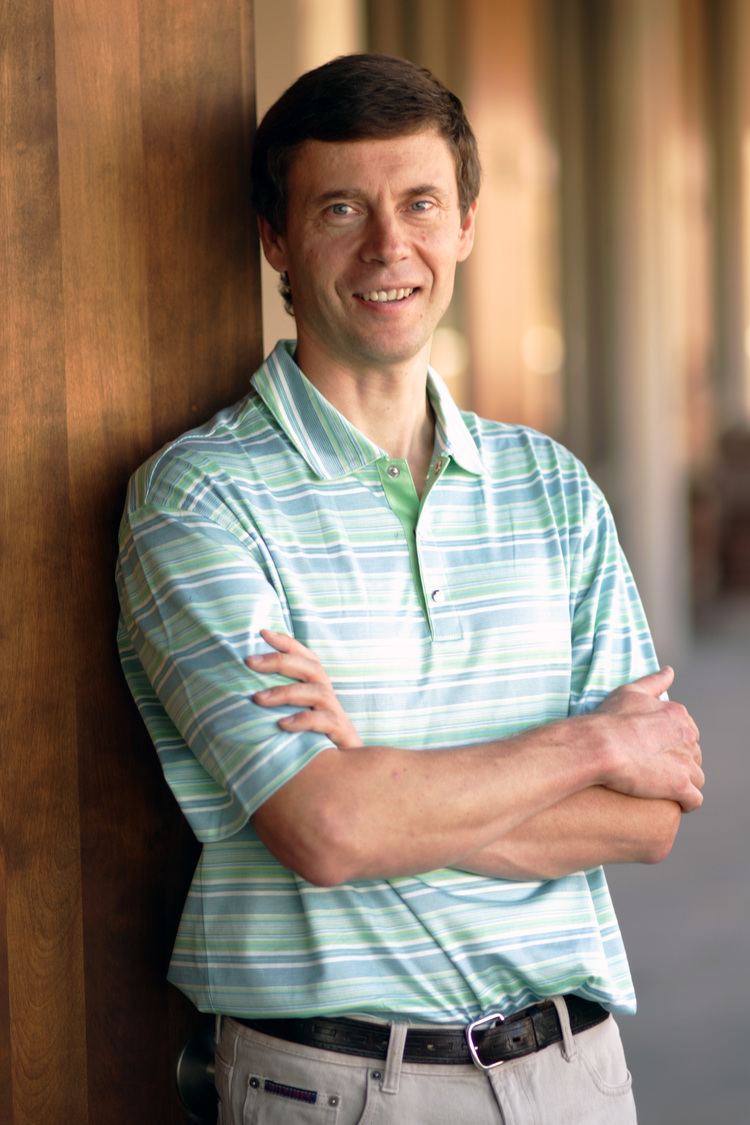
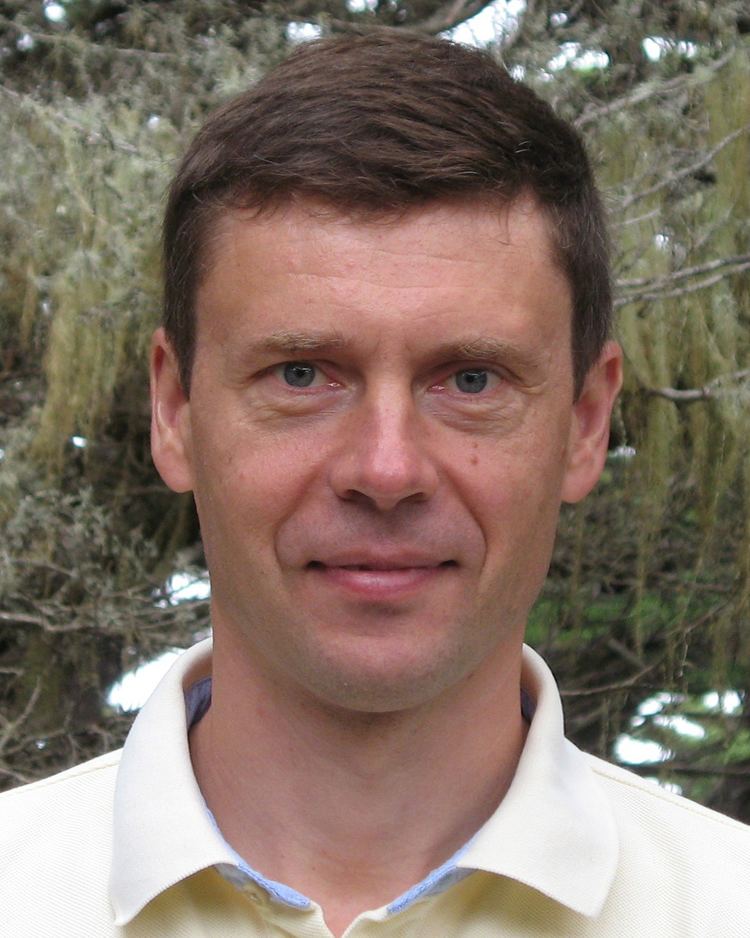
Alexei Yurievich Kitaev (Russian: Алексей Юрьевич Китаев; born August 26, 1963) is a Russian-American theoretical physicist.
He is currently a professor of theoretical physics and mathematics at the California Institute of Technology and is a permanent member of the Kavli Institute for Theoretical Physics.
Kitaev has received multiple awards for his contributions to the field of quantum mechanics, specifically quantum computing.
Life
Kitaev was educated in Russia, graduating from the Moscow Institute of Physics and Technology in 1986, and with a Ph.D. from the Landau Institute for Theoretical Physics under the supervision of Valery Pokrovsky in 1989.
Kitaev worked as a research associate at the Landau Institute between 1989 and 1998. Between 1999 and 2001, he served as a researcher at Microsoft Research. Since 2002, Kitaev has been a professor at Caltech.
In 2021, Kitaev was elected into the National Academy of Sciences.
Research
Toy models
Kitaev has introduced many toy models in the fields of solid-state physics and quantum mechanics. In his words:
Throughout my career I have been successful inventing toy models, some simple models that capture important features of a more complex problem.
Kitaev's toric code has since been found to describe several physical situations, such as quantum dimer models and atoms in certain Rydberg blockades.
Another toy model is Kitaev's honeycomb model, which is an exactly solvable lattice model for topological order with non-abelian anyons. This model is notable not only for being one of the first examples of an explicit Hamiltonian with non-abelian anyons, but also due to the fact that the Hamiltonian is amenable to experimental realization. Many materials have since been found whose effective Hamiltonians are similar to the honeycomb model, and such materials are known as Kitaev spin liquids.
It is believed that all invertible topological phases in two dimensions are obtained by stacking copies of Kitaev's E8 state.
Classification of topological phases
A classification result is Kitaev's 16-fold way, which gives a periodic description of the anyons in the Kitaev spin liquids based on their Chern numbers modulo 16, which can be rephrased in terms of a classification result for minimal fermionic topological phases.
Fault-tolerant quantum computation
Since 2021 Kitaev has worked with Google Quantum AI on their experimental effort of realizing fault-tolerant quantum computation, whose efforts have made extensive use of the toric code.
Honors and awards
Political activism
In March, 2022, he was one of 78 Breakthrough Prize Laureates whose names appeared on an "open letter" criticizing the Russian invasion of Ukraine.
See also
- Kitaev chain
- Magic state distillation
- Quantum threshold theorem
- Quantum Interactive Polynomial time
- Solovay–Kitaev theorem
- Topological entanglement entropy
- Toric code
References
External links
- http://www.macfound.org/fellows/802/